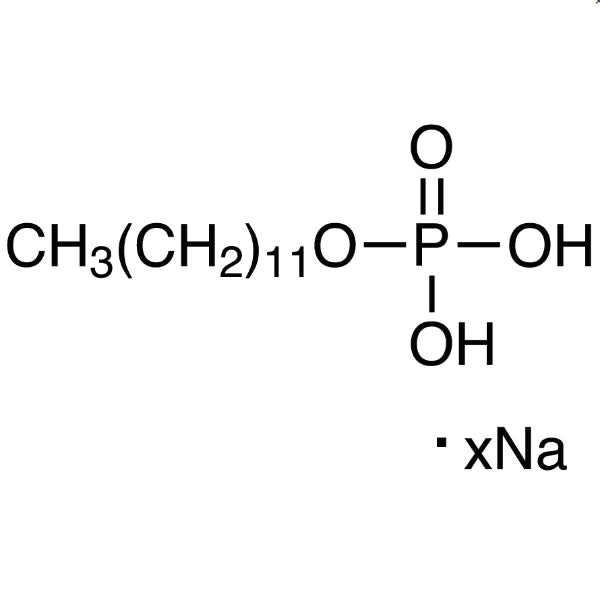
Sodium Monododecyl Phosphate (NaDDP), with CAS number 17026-83-4, is a chemical compound widely used as a polymer additive in laboratory settings. It serves as a surfactant and emulsifier, playing a crucial role in the formulation of materials that require surface tension reduction or improved dispersion properties. This compound is particularly valuable in polymer science and macromolecular research, where it aids in the synthesis and processing of various polymeric materials. Its presence in laboratory applications highlights its versatility and effectiveness in enhancing the performance of chemical formulations.
The non-ionic nature of Sodium Monododecyl Phosphate makes it a preferred choice for applications requiring stable emulsification and low surface tension. Its molecular structure allows it to act as both a wetting agent and a dispersing agent, making it suitable for a wide range of chemical processes. This compound is also known for its ability to improve the compatibility of different substances, which is essential in the development of complex chemical systems. These properties make it an essential component in both academic and industrial research environments.
In Indonesian laboratories, Sodium Monododecyl Phosphate is commonly used in chemical, material, and environmental research. It is frequently found in polymer development, chemical formulation studies, and molecular interaction analyses. Its availability in practical packaging formats supports its use across various research institutions, facilitating both experimentation and storage. The compound's reliability and effectiveness have made it a standard in many laboratory workflows.
TCI brochures (PDF)
- Polymer Additives 2026-04-16 · p. 11
Related TCI products
- TCI T0768 3055-94-5 Triethylene Glycol Monododecyl Ether
- TCI P0671 9002-92-0 Polyethylene Glycol Monododecyl Ether (n=approx 25)
- TCI P0372 3055-95-6 Pentaethylene Glycol Monododecyl Ether
- TCI O0139 3055-98-9 Octaethylene Glycol Monododecyl Ether
- TCI N1204 3055-99-0 Nonaethylene Glycol Monododecyl Ether [for Biochemical Research]
- TCI H0444 3055-96-7 Hexaethylene Glycol Monododecyl Ether
- Polymer synthesis and processing where surfactant properties are required for improved dispersion and compatibility.
- Emulsification of hydrophobic and hydrophilic components in chemical formulations to enhance stability and mixing.
- Surface tension reduction in coating and film-forming applications to improve adhesion and uniformity.
- Molecular interaction studies involving surface-active agents to analyze interfacial behavior and compatibility.
- Environmental research focused on the behavior of surfactants in aqueous systems and their impact on surface properties.
| Brand | TCI |
|---|---|
| CAS number | 17026-83-4 |
| Molecular formula | — |
| Purity | — |
| Category | Materials Science > Polymer/Macromolecule Reagents > Polymer Additives |
| Pack sizes | Available in various sizes as per standard laboratory requirements |
| Physical form | Solid powder |
| Storage | Store in a cool, dry place away from moisture and direct sunlight |
Sodium Monododecyl Phosphate should be stored in a cool, dry environment to maintain its chemical integrity. It is recommended to keep it in airtight containers to prevent moisture absorption, which could affect its performance. The compound is non-hazardous under normal conditions but should be handled with care to avoid direct contact with skin or eyes. It is advisable to store it away from incompatible substances such as strong acids or bases. Proper labeling and storage conditions ensure its effectiveness and safety in laboratory settings. Regular inspection of storage containers is recommended to ensure they remain sealed and undamaged.
—
Product Categories
Produk Terkait
-
TriethyleneGlycolMonododecylEther TCI T0768
Regular price Rp 18.628.050,00Regular price -
PolyethyleneGlycolMonododecylEther(n=approx25) TCI P0671
Regular price From Rp 477.750,00Regular price -
PentaethyleneGlycolMonododecylEther TCI P0372
Regular price Rp 18.550.350,00Regular price -
OctaethyleneGlycolMonododecylEther TCI O0139
Regular price From Rp 3.843.000,00Regular price -
NonaethyleneGlycolMonododecylEther[forBiochemicalResearch] TCI N1204
Regular price From Rp 980.700,00Regular price -
HexaethyleneGlycolMonododecylEther TCI H0444
Regular price Rp 5.724.600,00Regular price -
DidodecylHydrogenPhosphate TCI P1068
Regular price From Rp 2.386.650,00Regular price -
DidodecylSuccinate TCI S0255
Regular price Rp 1.193.850,00Regular price


![3055-99-0 Nonaethylene Glycol Monododecyl Ether [for Biochemical Research] - AMI Scientific](http://amiscientific.com/cdn/shop/files/TCI2510N1204.jpg?v=1768362176&width=533)