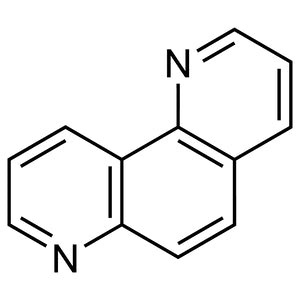
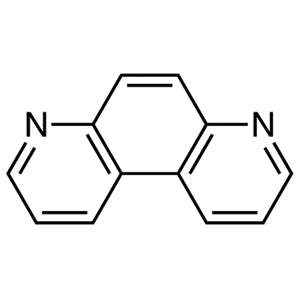
1,10-Phenanthroline is a chemical compound widely used in various chemical reactions, particularly in the fields of catalysis and inorganic chemistry. It is a nitrogen-donor ligand that plays a crucial role in metal complex synthesis and qualitative and quantitative metal analysis. This compound is known for its ability to form stable complexes with transition metals, making it an essential tool in laboratory settings. Its versatility and effectiveness have made it a popular choice among researchers and chemists worldwide.
The compound exhibits stable chemical properties and good solubility in organic solvents, which facilitates its use in diverse experimental conditions. Its clear coloration also aids in visual observation during chemical reactions and analytical procedures. These characteristics contribute to its reliability and ease of handling in laboratory environments. Additionally, its consistent performance and availability make it a preferred choice for both academic and industrial research.
In Indonesian laboratories, 1,10-Phenanthroline is commonly used in chemical research, especially in higher education institutions and research organizations. Its ability to support complex chemical experiments and its role in metal analysis make it an indispensable reagent. Researchers in Indonesia frequently rely on this compound due to its effectiveness and accessibility, ensuring consistent results in their studies.
TCI brochures (PDF)
- Ligands 2025-12-01 · p. 14
Related TCI products
- TCI B4456 22426-14-8 2-Bromo-1,10-phenanthroline
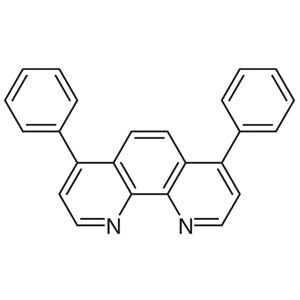
- TCI B2695 1662-01-7 Bathophenanthroline (purified by sublimation)
- TCI B2632 66127-01-3 3-Bromo-1,10-phenanthroline
- TCI B0989 53744-42-6 Bathophenanthrolinedisulfonic Acid Disodium Salt Hydrate [for Determination of Ferrous Ion]
- TCI A2977 54258-41-2 5-Amino-1,10-phenanthroline
- TCI T0847 1660-93-1 3,4,7,8-Tetramethyl-1,10-phenanthroline
- Metal complex synthesis where it enhances reactivity and stability of metal-ligand interactions.
- Qualitative and quantitative metal analysis due to its ability to form colored complexes with transition metals.
- Catalytic processes in inorganic chemistry where it acts as a nitrogen-donor ligand to improve reaction efficiency.
- Spectrophotometric analysis as its clear coloration allows for accurate measurement of metal ion concentrations.
- Teaching demonstrations in chemistry courses to illustrate ligand-metal bonding and complex formation.
| Brand | TCI |
|---|---|
| CAS number | 66-71-7 |
| Molecular formula | — |
| Purity | — |
| Category | Chemistry > Catalysis and Inorganic Chemistry > Nitrogen-Donor Ligands [Catalysis] |
| Pack sizes | Available in various quantities as per standard laboratory requirements |
| Physical form | Solid |
| Storage | Store in a cool, dry place away from direct sunlight and moisture |
1,10-Phenanthroline should be stored in a cool, dry place, away from direct sunlight and moisture to maintain its chemical stability. It is recommended to use airtight containers to prevent exposure to air and humidity. Due to its potential reactivity with certain substances, it should be handled in a well-ventilated area and stored separately from strong oxidizing agents. Laboratory personnel should wear appropriate personal protective equipment, such as gloves and safety goggles, when handling this compound. Regular inspection of storage conditions is advised to ensure the compound remains in optimal condition for use. Proper labeling of containers is essential to prevent accidental misuse or contamination.
—
Produk Terkait
-
2-Bromo-1,10-phenanthroline TCI B4456
Regular price From Rp 3.312.750,00Regular price -
Bathophenanthroline(purifiedbysublimation) TCI B2695
Regular price Rp 5.432.700,00Regular price -
3-Bromo-1,10-phenanthroline TCI B2632
Regular price Rp 3.683.400,00Regular price -
BathophenanthrolinedisulfonicAcidDisodiumSaltHydrate[forDeterminationofFerrousIon] TCI B0989
Regular price Rp 5.672.100,00Regular price -
5-Amino-1,10-phenanthroline TCI A2977
Regular price Rp 3.738.000,00Regular price -
3,4,7,8-Tetramethyl-1,10-phenanthroline TCI T0847
Regular price From Rp 2.094.750,00Regular price -
1,7-Phenanthroline TCI P3288
Regular price From Rp 1.565.550,00Regular price -
4,7-Phenanthroline TCI P2684
Regular price From Rp 2.466.450,00Regular price


![53744-42-6 Bathophenanthrolinedisulfonic Acid Disodium Salt Hydrate [for Determination of Ferrous Ion] - AMI Scientific](http://amiscientific.com/cdn/shop/files/TCI2510B0989.jpg?v=1768193262&width=533)