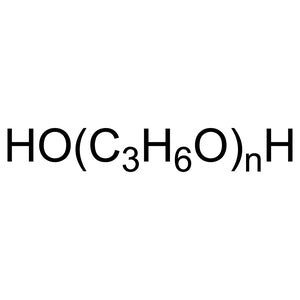
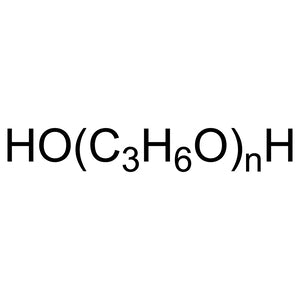
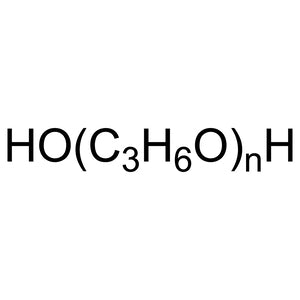
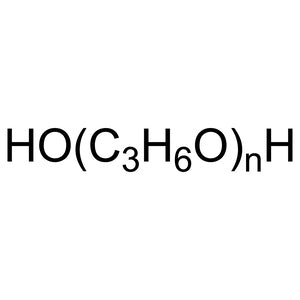
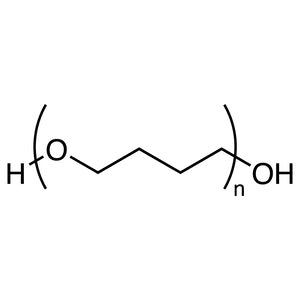
Poly(propylene glycol) 600 is a polyether diol from TCI's PPG series, with a nominal average molecular weight of 600. Its structure is a chain of repeating propylene oxide units capped with a hydroxyl group at each end. In the laboratory, PPG 600 serves as a polyol for building condensation and polyaddition polymers and as a starting material for macromonomer synthesis. It is also used as a formulation component where a polyether liquid of intermediate chain length is needed.
Compared with PPG 200 and PPG 400, PPG 600 has a longer chain. When it is built into a polymer, it adds more flexible segments, while its hydroxyl content is still high enough to give meaningful crosslink density. Its viscosity is slightly higher than that of the lighter grades, but it remains easy to handle as a liquid. The pendant methyl group on each propylene oxide unit makes PPG more hydrophobic than polyethylene glycol of similar length, and researchers often use this property when designing amphiphilic polymers.
For laboratories in Indonesia, PPG 600 supports research into elastomers, flexible adhesives, coatings, and functional polymer materials at both universities and industrial laboratories. Polymer chemistry and materials science groups can use it in formulation studies, in comparisons with lighter or heavier PPG grades, and in experiments on how polyether segment length affects the flexibility and hydrophobicity of the final material. AMI Scientific supplies this TCI reagent for these research and development needs.
TCI brochures (PDF)
- Monomers 2025-05-28 · p. 26
Related TCI products
- Polyurethane and polyaddition synthesis: the two terminal hydroxyl groups let PPG 600 act as a diol building block that adds flexible polyether soft segments to the polymer backbone.
- Condensation polymer research: as a polyol of intermediate chain length, it lets researchers make polyesters and related polymers with flexible segments while keeping useful crosslink density.
- Macromonomer preparation: the reactive hydroxyl end groups can be functionalized, so PPG 600 is a practical starting material for polyether macromonomers used in later polymerization steps.
- Amphiphilic polymer engineering: the pendant methyl groups make PPG more hydrophobic than polyethylene glycol, which makes it useful for building the hydrophobic blocks of amphiphilic structures.
- Elastomer, adhesive, and coating formulation: its longer chain gives more flexibility than PPG 200 or 400, which helps when studying flexible adhesives, elastomers, and coating materials.
| Brand | TCI (product code P3275) |
|---|---|
| CAS number | 25322-69-4 |
| Molecular formula | — |
| Purity | — |
| Category | Materials Science > Polymer/Macromolecule Reagents > Monomers |
| Pack sizes | see the product page for the TCI pack sizes currently offered |
| Physical form | liquid polyether diol, nominal average molecular weight 600 |
| Storage | keep the container tightly closed in a cool, dry, well-ventilated place, following the TCI label and Safety Data Sheet |
Store Poly(propylene glycol) 600 in its original, tightly sealed TCI container in a cool, dry, well-ventilated area, away from direct sunlight, heat sources, and incompatible materials such as strong oxidizing agents. Reseal the container promptly after each use so the hydroxyl-terminated polymer does not pick up moisture or contaminants. If you need to transfer it, use clean, dry glass or chemically compatible containers and label them clearly. Wear standard laboratory protective equipment, including safety glasses, gloves, and a lab coat. Avoid contact with skin and eyes, wipe up spills quickly because the viscous liquid can make surfaces slippery, and always read the product's Safety Data Sheet before use.
—
Produk Terkait
-
Poly(propyleneglycol)4000 TCI P3279
Regular price From Rp 557.550,00Regular priceRp 405.300,00Sale price From Rp 557.550,00 -
Poly(propyleneglycol)3000 TCI P3278
Regular price From Rp 557.550,00Regular priceRp 405.300,00Sale price From Rp 557.550,00 -
Poly(propyleneglycol)2000 TCI P3277
Regular price From Rp 557.550,00Regular priceRp 405.300,00Sale price From Rp 557.550,00 -
Poly(propyleneglycol)1000 TCI P3276
Regular price From Rp 557.550,00Regular priceRp 405.300,00Sale price From Rp 557.550,00 -
Poly(propyleneglycol)400 TCI P3274
Regular price From Rp 557.550,00Regular priceRp 405.300,00Sale price From Rp 557.550,00 -
Poly(propyleneglycol)200 TCI P3273
Regular price From Rp 557.550,00Regular priceRp 405.300,00Sale price From Rp 557.550,00 -
Poly(tetramethyleneether)Glycol2900 TCI P3031
Regular price From Rp 717.150,00Regular priceRp 500.850,00Sale price From Rp 717.150,00 -
Poly(tetramethyleneether)Glycol2000 TCI P3028
Regular price From Rp 717.150,00Regular priceRp 500.850,00Sale price From Rp 717.150,00