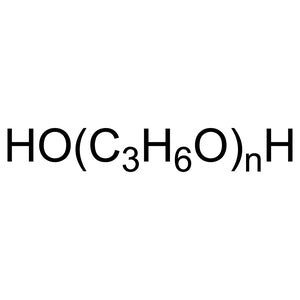
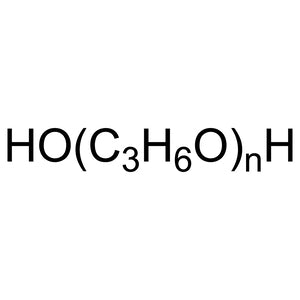
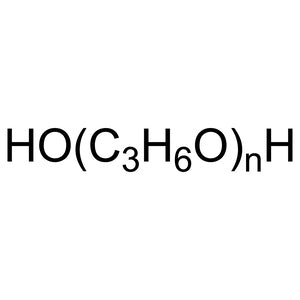
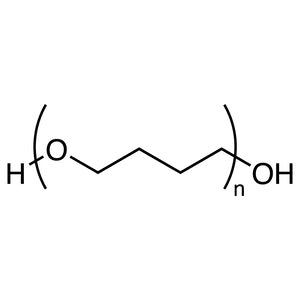
Poly(propylene glycol) 3000 is a high-molecular-weight polyether diol with a nominal average molecular weight of 3000. It is built from long propylene oxide chains and carries hydroxyl groups at both ends. Within the TCI PPG series, this grade is a long-chain polyol intended for producing highly flexible polymers. In the laboratory, PPG 3000 is used to synthesise soft elastomers, flexible foams and pressure-sensitive adhesives. It also serves as a hydrophobic block in copolymers, giving researchers a dependable difunctional building block for polymer and materials work.
The main advantage of PPG 3000 is its very long soft segment. Polymer networks made from it have low crosslink density, high softness and good stretchability. Because it has fewer hydroxyl groups per unit mass than shorter PPG grades, formulations need less isocyanate or crosslinker. At this chain length the polypropylene oxide backbone is clearly hydrophobic and practically immiscible with water. It is still compatible with many organic solvents and nonpolar formulation components, so it can be used across a wide range of synthesis and formulation systems.
For laboratories in Indonesia, PPG 3000 supports research on soft materials such as cushioning, seals, elastomers for automotive components and flexible coatings. It is also useful in colloid chemistry research that needs a well-defined hydrophobic block. University polymer groups, industrial R&D teams and formulation laboratories can use this TCI reagent to study how soft-segment length affects flexibility, elongation and network structure in polyurethane and copolymer systems.
TCI brochures (PDF)
- Monomers 2025-05-28 · p. 26
Related TCI products
- Soft elastomer synthesis: the long polyether soft segment produces networks with low crosslink density, giving the high softness and elongation needed for flexible elastomer research.
- Flexible foam development: as a long-chain diol, PPG 3000 helps produce flexible polymer structures and needs less isocyanate because it has fewer hydroxyl groups per unit mass.
- Pressure-sensitive adhesive formulation: its soft, highly flexible segments and compatibility with nonpolar formulation components make it a suitable polyol for researching soft, tacky adhesive systems.
- Hydrophobic block in copolymers: the clearly hydrophobic polypropylene oxide chain, with reactive hydroxyl groups at both ends, makes it a convenient hydrophobic segment for building block copolymers.
- Colloid chemistry and flexible coatings research: water immiscibility combined with good organic solvent compatibility makes it useful for studying interfacial behaviour and developing flexible coating formulations.
| Brand | TCI (product code P3278) |
|---|---|
| CAS number | 25322-69-4 |
| Molecular formula | nominal average 3000 (hydroxyl-terminated polyether diol) |
| Purity | — |
| Category | Materials Science > Polymer/Macromolecule Reagents > Monomers |
| Pack sizes | available in TCI standard pack sizes; please confirm current options with our team |
| Physical form | — |
| Storage | keep tightly closed in a cool, dry place, following the TCI label and Safety Data Sheet |
Store Poly(propylene glycol) 3000 in its original, tightly closed container in a cool, dry and well-ventilated area, away from direct sunlight, heat sources and strong oxidising agents. Reseal the container promptly after use to limit moisture uptake, because absorbed water can interfere with reactions involving isocyanates or other hydroxyl-reactive crosslinkers. If you transfer the material, use clean, dry glass or compatible chemical-resistant containers and label them clearly. Follow standard laboratory practice: wear safety glasses, gloves and a lab coat, avoid contact with skin and eyes, and clean up spills promptly to prevent slippery surfaces. Read the TCI Safety Data Sheet before use, and dispose of waste according to local regulations and your institution's procedures.
—
Produk Terkait
-
Poly(propyleneglycol)4000 TCI P3279
Regular price From Rp 557.550,00Regular priceRp 405.300,00Sale price From Rp 557.550,00 -
Poly(propyleneglycol)2000 TCI P3277
Regular price From Rp 557.550,00Regular priceRp 405.300,00Sale price From Rp 557.550,00 -
Poly(propyleneglycol)1000 TCI P3276
Regular price From Rp 557.550,00Regular priceRp 405.300,00Sale price From Rp 557.550,00 -
Poly(propyleneglycol)600 TCI P3275
Regular price From Rp 557.550,00Regular priceRp 405.300,00Sale price From Rp 557.550,00 -
Poly(propyleneglycol)400 TCI P3274
Regular price From Rp 557.550,00Regular priceRp 405.300,00Sale price From Rp 557.550,00 -
Poly(propyleneglycol)200 TCI P3273
Regular price From Rp 557.550,00Regular priceRp 405.300,00Sale price From Rp 557.550,00 -
Poly(tetramethyleneether)Glycol2900 TCI P3031
Regular price From Rp 717.150,00Regular priceRp 500.850,00Sale price From Rp 717.150,00 -
Poly(tetramethyleneether)Glycol2000 TCI P3028
Regular price From Rp 717.150,00Regular priceRp 500.850,00Sale price From Rp 717.150,00