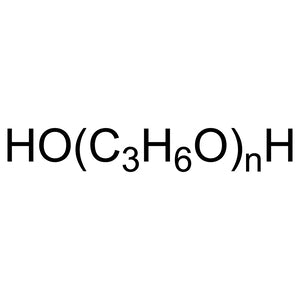
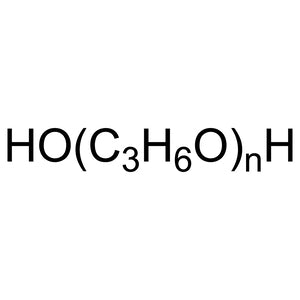
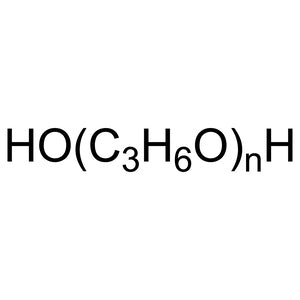
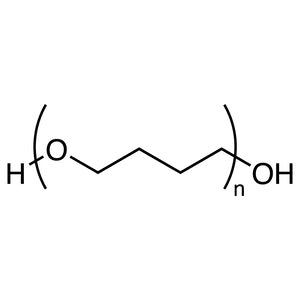
Poly(propylene glycol) 4000 is the highest molecular weight member of this PPG series, with a nominal average molecular weight of 4000. This polyether diol consists of a very long chain of propylene oxide units, with a hydroxyl group at each end. In the laboratory, PPG 4000 is used to build polymers with the longest soft segments in the series, such as highly flexible elastomers, sealants and flexible coatings. It also serves as a long hydrophobic block when designing copolymers.
PPG 4000 stands out because of its chain length, which gives the widest possible spacing between crosslinks and high flexibility in the finished material. It has the lowest hydroxyl content per unit mass in this series, so its reaction with isocyanates produces a soft, elastic network. The chain is strongly hydrophobic and practically insoluble in water, but it remains compatible with many organic solvents. Although viscous, the material is generally still a liquid, so it can be handled with standard laboratory equipment.
For Indonesian laboratories, PPG 4000 is useful in research on construction sealants, elastomeric coatings, flexible adhesives and soft materials for automotive applications. University polymer research groups, industrial R&D teams and formulation laboratories can use it as a reference soft-segment building block. It makes it easier to study systematically how chain length affects flexibility, elasticity and the final performance of polyurethane and related polymer systems.
TCI brochures (PDF)
- Monomers 2025-05-28 · p. 26
Related TCI products
- Flexible polyurethane elastomers: its very long polyether chain and low hydroxyl content give soft, highly elastic networks when it reacts with isocyanates.
- Construction sealant research: the long soft segments give the high flexibility and elasticity that sealant formulations need to accommodate joint movement.
- Elastomeric and flexible coatings: maximum crosslink spacing gives coating films that stay pliable, which suits studies of flexibility in protective coating systems.
- Flexible adhesive development: its soft, elastic polyol backbone helps researchers formulate adhesives that keep bonds flexible rather than brittle in the cured material.
- Block copolymer design: its strongly hydrophobic, water-insoluble chain serves as a long hydrophobic block when building amphiphilic or segmented copolymer architectures.
| Brand | TCI (product code P3279) |
|---|---|
| CAS number | 25322-69-4 |
| Molecular formula | — |
| Purity | — |
| Category | Materials Science > Polymer/Macromolecule Reagents > Monomers |
| Pack sizes | available in the pack sizes offered by TCI for this product |
| Physical form | viscous liquid; nominal average molecular weight 4000 |
| Storage | keep tightly closed in a cool, dry place, following the TCI label and Safety Data Sheet |
Store Poly(propylene glycol) 4000 in its original, tightly closed container in a cool, dry, well-ventilated area, away from direct sunlight, heat sources and strong oxidizing agents. Keep the container sealed when not in use so moisture does not affect hydroxyl-reactive formulations such as polyurethane systems. Because the liquid is viscous, use suitable pipettes, spatulas or weighing methods to measure it accurately. Follow standard laboratory practice: wear safety glasses, gloves and a lab coat, avoid contact with eyes and skin, clean up spills promptly, and always check the product's Safety Data Sheet for specific guidance.
—
Produk Terkait
-
Poly(propyleneglycol)3000 TCI P3278
Regular price From Rp 557.550,00Regular priceRp 405.300,00Sale price From Rp 557.550,00 -
Poly(propyleneglycol)2000 TCI P3277
Regular price From Rp 557.550,00Regular priceRp 405.300,00Sale price From Rp 557.550,00 -
Poly(propyleneglycol)1000 TCI P3276
Regular price From Rp 557.550,00Regular priceRp 405.300,00Sale price From Rp 557.550,00 -
Poly(propyleneglycol)600 TCI P3275
Regular price From Rp 557.550,00Regular priceRp 405.300,00Sale price From Rp 557.550,00 -
Poly(propyleneglycol)400 TCI P3274
Regular price From Rp 557.550,00Regular priceRp 405.300,00Sale price From Rp 557.550,00 -
Poly(propyleneglycol)200 TCI P3273
Regular price From Rp 557.550,00Regular priceRp 405.300,00Sale price From Rp 557.550,00 -
Poly(tetramethyleneether)Glycol2900 TCI P3031
Regular price From Rp 717.150,00Regular priceRp 500.850,00Sale price From Rp 717.150,00 -
Poly(tetramethyleneether)Glycol2000 TCI P3028
Regular price From Rp 717.150,00Regular priceRp 500.850,00Sale price From Rp 717.150,00