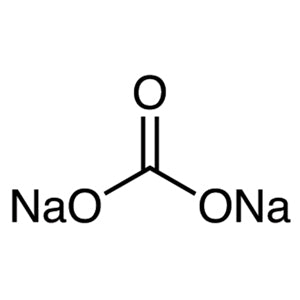
Sodium carbonate (Na₂CO₃), with CAS number 497-19-8, is an inorganic compound widely used in laboratory experiments across various chemical disciplines. It is a white, odorless solid that plays a crucial role in chemical reactions, particularly in neutralization processes and the synthesis of other compounds. As a strong base, sodium carbonate is essential for maintaining the desired pH levels in experimental setups, making it a versatile reagent in both qualitative and quantitative analyses. Its chemical stability and reactivity under controlled conditions make it a reliable choice for researchers and educators alike.
One of the key properties that make sodium carbonate a preferred choice is its high solubility in water, allowing it to be easily dissolved into solutions for various applications. It is chemically inert in air, ensuring that it does not degrade or react with atmospheric components during storage or use. Additionally, its ability to neutralize acids makes it particularly valuable in acid-base titrations and other reactions where pH control is critical. These characteristics contribute to its widespread use in both academic and industrial laboratory settings.
In Indonesian laboratories, sodium carbonate is commonly used in analytical chemistry, organic chemistry, and industrial processes. Its role in creating alkaline environments is vital for experiments requiring specific pH conditions. It is also used in the preparation of standard solutions and in the precipitation of certain compounds. Due to its stability and effectiveness, sodium carbonate remains a fundamental reagent in the chemical toolkit of Indonesian laboratories.
TCI brochures (PDF)
- Sulfonium Salt for Both Trifluoromethylation and Mesitylation 2025-01-07 · p. 1
- Organic Photoreaction Reagents 2025-02-13 · p. 5
- C-H Bond Activation Reaction 2025-06-20 · p. 10
- Metallic Salts 2025-11-06 · p. 9
- Suzuki-Miyaura Cross Coupling Reaction 2025-12-01 · p. 27
- Sodium carbonate is widely used in analytical chemistry for pH adjustment and titration experiments due to its strong basic properties and solubility in water.
- In organic chemistry, it serves as a base catalyst in various reactions, facilitating the formation of desired products under controlled conditions.
- Industrial laboratories often use sodium carbonate in the production of glass, paper, and detergents, where it acts as a key component in chemical processes.
- It is commonly employed in the preparation of buffer solutions, which are essential for maintaining stable pH levels in biochemical and biological experiments.
- Sodium carbonate is also used in the synthesis of other inorganic compounds, where its basic nature helps in the precipitation and isolation of specific products.
From the TCI brochure
- Base used in trifluoromethylation schemes with D5889
| Brand | TCI |
|---|---|
| CAS number | 497-19-8 |
| Molecular formula | — |
| Purity | — |
| Category | Chemistry > Catalysis and Inorganic Chemistry > Main-group Elements |
| Pack sizes | Available in various quantities as per standard laboratory supply sizes |
| Physical form | White solid |
| Storage | Store in a cool, dry place away from moisture and direct sunlight |
Sodium carbonate should be stored in a cool, dry place to prevent moisture absorption, which can affect its solubility and reactivity. It is recommended to use airtight containers to maintain its chemical stability and prevent contamination. Due to its basic nature, it is important to handle it with appropriate personal protective equipment, such as gloves and safety goggles, to avoid skin or eye contact. In laboratory settings, it should be kept away from acidic substances to prevent unwanted reactions. Proper labeling and storage conditions ensure the safety of both the material and the personnel working with it.
References cited in the TCI brochure
- Chip Le. A radical approach to the copper oxidative addition problem: Trifluoromethylation of bromoarenes Science, 2018. doi:10.1126/science.aat4133
- David J. P. Kornfilt. Copper-Catalyzed Trifluoromethylation of Alkyl Bromides Journal of the American Chemical Society, 2019. doi:10.1021/jacs.9b03024
Product Categories
- Catalysis and Inorganic ChemistryMain-group Elements [Catalysis and Inorganic Chemistry]Sodium [Catalysis and Inorganic Chemistry]
- Catalysis and Inorganic ChemistryCross-coupling Reaction using Transition Metal Catalysts [C-C Bond Formation]Bases and Additives [Cross-coupling Reaction using Transition Metal Catalysts]
- Catalysis and Inorganic ChemistryMetallic Salts [Catalysis and Inorganic Chemistry]Carbonate Salts [Metallic Salts]
- Synthetic ReagentsAcids, Bases [Synthetic Reagents]Bases [Synthetic Reagents]
- Synthetic ReagentsC-C Bond Formation [Synthetic Reagents]Cross-coupling Reaction using Transition Metal Catalysts [C-C Bond Formation]
- Synthetic ReagentsC-X(Non-Halogen) Bond Formation [Synthetic Reagents]C-H Bond Activation Reaction [Synthetic Reagents]
Produk Terkait
-
CesiumCarbonate TCI C2160
Regular price From Rp 1.326.150,00Regular price -
PotassiumCarbonate TCI P1748
Regular price Rp 505.050,00Regular price -
LithiumCarbonate TCI L0224
Regular price From Rp 505.050,00Regular price -
SodiumHydrogenCarbonate TCI S0561
Regular price Rp 584.850,00Regular price -
PotassiumHydroxide(Powder) TCI P2844
Regular price From Rp 505.050,00Regular price -
SodiumHydroxide(Granulated) TCI O0575
Regular price From Rp 477.750,00Regular price -
LithiumHydroxideAnhydrous TCI L0225
Regular price From Rp 980.700,00Regular price -
SodiumPivalateHydrate TCI S0978
Regular price From Rp 1.220.100,00Regular price