

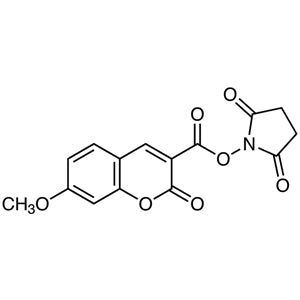
N-Succinimidyl 7-Methoxycoumarin-3-carboxylate is a chemical compound widely used in biochemical and biotechnological applications within laboratory settings. This fluorescent ligand plays a crucial role in labeling and detecting biomolecules, particularly proteins and other biological structures. Its ability to covalently bind to amino groups makes it an essential tool for functional studies and molecular characterization. In research environments, it is commonly employed to investigate molecular interactions and structural properties, supporting a wide range of experimental approaches.
The compound is favored for its strong fluorescent properties, which allow for high-sensitivity detection of target molecules. This characteristic makes it ideal for use in techniques such as Western blotting, ELISA, and protein interaction studies. Its stability under standard laboratory conditions further enhances its reliability and ease of use. Researchers can confidently incorporate this compound into their workflows without concerns about degradation or loss of activity.
In Indonesian laboratories, N-Succinimidyl 7-Methoxycoumarin-3-carboxylate is extensively used in biomedical, pharmacological, and biotechnological research. Local scientists rely on this compound for molecular interaction studies and the development of more accurate detection methods. Its versatility and performance make it a preferred choice for both academic and industrial research applications.
Advantages (TCI brochure)
- Blue fluorescence
- Fluorescence spectra do not depend on pH
TCI brochures (PDF)
- Fluorescent Labeling Dyes 2025-11-18 · p. 1
- Reagents for Biological Research 2025-03-11 · p. 4
Related TCI products
- TCI S0866 134471-24-2 N-Succinimidyl 7-Hydroxycoumarin-3-carboxylate
- TCI C2479 92557-80-7 5-Carboxyfluorescein N-Succinimidyl Ester
- TCI S0503 1858255-08-9 Succinimidyl 6-[[7-(N,N-Dimethylaminosulfonyl)-2,1,3-benzoxadiazol-4-yl]amino]hexanoate
- TCI F0810 75350-46-8 Fluorescein-5-maleimide (contains 2% N,N-Dimethylformamide at maximum)
- TCI F0783 18861-78-4 Fluorescein 6-Isothiocyanate (isomer II)
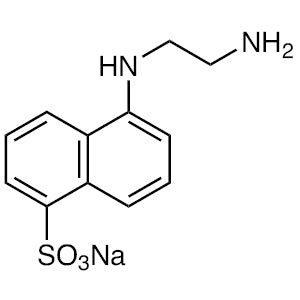
- TCI S0891 100900-07-0 Sodium 5-(2-Aminoethylamino)-1-naphthalenesulfonate
- Protein-protein interaction mapping in complex biological systems benefits from its ability to label and track molecular interactions with high specificity.
- Fluorescence-based structural analysis of biomolecules allows for non-invasive visualization of molecular architecture and conformational changes.
- Development of molecular detection techniques requires a reliable fluorescent probe that maintains stability and sensitivity across various experimental conditions.
- Protein-ligand interaction studies utilize its covalent binding properties to assess binding affinities and interaction dynamics.
- Biomedical research applications leverage its fluorescent properties to monitor biological processes and evaluate therapeutic targets.
From the TCI brochure
- Can be labeled to amino groups
| Brand | TCI |
|---|---|
| CAS number | 150321-92-9 |
| Molecular formula | — |
| Purity | — |
| Category | Life Science > Antibodies > Antibody Supplementary Products |
| Pack sizes | — |
| Physical form | — |
| Storage | Store at room temperature in a dry place away from light |
Data from the TCI brochure
| λex,max | 360 nm (pH7 buffer) |
|---|---|
| λem,max | 410 nm (pH7 buffer) |
Source: TCI brochure LL039 (2025-11-18)
This compound should be stored at room temperature in a dry, cool environment, away from direct light to maintain its stability and fluorescent properties. It is recommended to use airtight containers to prevent moisture absorption, which could affect its performance. Due to its chemical nature, it should be handled with appropriate personal protective equipment, such as gloves and safety goggles, to ensure laboratory safety. While it is not classified as hazardous under standard conditions, care should be taken to avoid contamination and ensure proper disposal according to local regulations. Regular monitoring of storage conditions is advised to maintain its integrity and effectiveness in research applications.
—
Product Categories
- AntibodiesAntibody Supplementary ProductsAntibody Modification
- Biochemicals and ReagentsFluorescent Probes, Fluorescent Labels, Fluorescent StainsDonors and Acceptors for FRET
- Biochemicals and ReagentsFluorescent Probes, Fluorescent Labels, Fluorescent StainsFluorescent Labels
- Molecular BiologyProteomicsProtein Structural Analysis
Produk Terkait
-
N-Succinimidyl7-Hydroxycoumarin-3-carboxylate TCI S0866
Regular price From Rp 5.724.600,00Regular price -
5-CarboxyfluoresceinN-SuccinimidylEster TCI C2479
Regular price From Rp 5.910.450,00Regular price -
Succinimidyl6-[[7-(N,N-Dimethylaminosulfonyl)-2,1,3-benzoxadiazol-4-yl]amino]hexanoate TCI S0503
Regular price Rp 9.752.400,00Regular price -
Fluorescein-5-maleimide(contains2%N,N-Dimethylformamideatmaximum) TCI F0810
Regular price Rp 5.512.500,00Regular price -
Fluorescein6-Isothiocyanate(isomerII) TCI F0783
Regular price Rp 8.613.150,00Regular price -
Sodium5-(2-Aminoethylamino)-1-naphthalenesulfonate TCI S0891
Regular price Rp 1.988.700,00Regular price -
N-Succinimidyl4-[4-(Dimethylamino)phenylazo]benzoate TCI S0857
Regular price From Rp 3.922.800,00Regular price -
5-Aminofluorescein(isomerI) TCI A0306
Regular price Rp 4.056.150,00Regular price


![1858255-08-9 Succinimidyl 6-[[7-(N,N-Dimethylaminosulfonyl)-2,1,3-benzoxadiazol-4-yl]amino]hexanoate - AMI Scientific](http://amiscientific.com/cdn/shop/files/TCI2510S0503.jpg?v=1768206279&width=533)


![146998-31-4 N-Succinimidyl 4-[4-(Dimethylamino)phenylazo]benzoate - AMI Scientific](http://amiscientific.com/cdn/shop/files/TCI2510S0857.jpg?v=1767139066&width=533)
