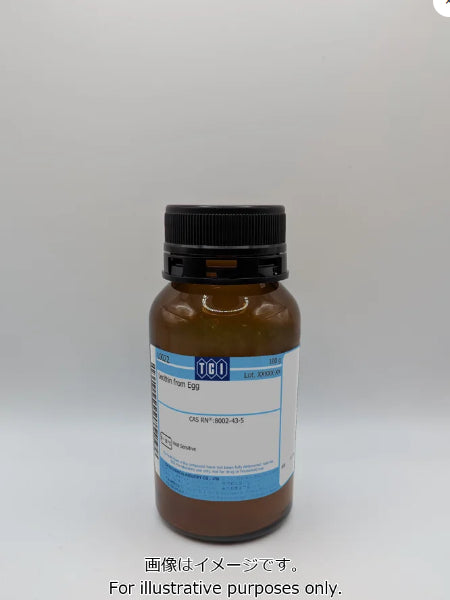

Lecithin from Egg is a natural mixture of phospholipids extracted from egg yolk, widely used as a base material for membrane research and active-substance delivery systems. Its principal component is phosphatidylcholine together with other phospholipids, which makes this material a simple yet representative model for studying the behaviour of lipid bilayers. In biochemistry and pharmaceutical laboratories, egg lecithin serves as a routine material for forming liposomes, vesicles and emulsions, and at the same time as a natural lipid source in studies of how drugs interact with biological membranes.
Egg-derived lecithin is chosen because its fatty acid profile differs from that of plant-derived lecithin, with a proportion of unsaturated chains that gives the resulting membranes more fluid properties at room temperature. Its amphiphilic character — a polar phosphate head group and two hydrophobic fatty acid tails — causes the molecules to arrange themselves spontaneously into bilayer structures when dispersed in water. This property is highly valued in formulation research because it allows vesicles to be formed without the need for additional synthetic surfactants. Reagent-grade material from TCI helps keep vesicle-formation behaviour uniform from one experiment to the next.
In Indonesia, this material is used across biochemistry, pharmacy and life science laboratories where membrane models and lipid-based carrier systems are prepared as part of routine study work. It supports teaching and research groups that need a dependable natural phospholipid source for liposome preparation, emulsion work and membrane interaction studies, and its consistent reagent-grade quality makes it suitable for laboratories that repeat the same preparation protocols across multiple experimental runs.
- Liposome preparation — the amphiphilic structure allows spontaneous bilayer assembly in aqueous dispersion, so vesicles form without requiring additional synthetic surfactants in the formulation.
- Lipid bilayer model studies — as a natural phospholipid mixture dominated by phosphatidylcholine, it provides a simple yet representative model system for examining bilayer behaviour.
- Drug–membrane interaction research — it serves as a natural lipid source for investigating how active pharmaceutical compounds interact with biological membrane structures under controlled laboratory conditions.
- Emulsion formulation work — the polar head and hydrophobic tail arrangement makes it an effective natural component for preparing and stabilising laboratory emulsion systems.
- Active-substance delivery system research — it acts as a base material for building carrier systems, with reagent-grade consistency supporting reproducible vesicle formation between experiments.
| Brand | TCI |
|---|---|
| CAS number | 8002-43-5 |
| Molecular formula | — |
| Purity | — |
| Category | Life Science > Biochemicals and Reagents > Lipids |
| Pack sizes | available in standard laboratory reagent pack sizes; please refer to the current catalogue listing |
| Physical form | — |
| Storage | store according to the conditions stated on the manufacturer's product label |
- Product code: L0022
Store this material under the conditions indicated on the manufacturer's label, keeping the container tightly closed and protected from air, moisture and direct light, since natural phospholipid mixtures containing unsaturated fatty acid chains are sensitive to oxidation. Use clean, dry glassware and closed containers when weighing and dispersing the material, and avoid repeated exposure of the bulk stock to ambient air. Handle in a well-ventilated laboratory area while wearing standard personal protective equipment, including a laboratory coat, gloves and eye protection. Prepare dispersions fresh where the experimental protocol requires it, and consult the safety data sheet supplied with the product before use.
—
Produk Terkait
-
TCI B5774 5,10-Bis(4,4,5,5-tetramethyl-1,3,2-dioxaborolan-2-yl)naphtho[1,2-c:5,6-c']bis([1,2,5]oxadiazole)
Regular price Rp 10.255.350,00Regular price -
Dihydroiodide TCI B6569
Regular price From Rp 1.936.200,00Regular price -
Trifluoromethanesulfonate TCI B7003
Regular price From Rp 1.936.200,00Regular price
![5,10-Bis(4,4,5,5-tetramethyl-1,3,2-dioxaborolan-2-yl)naphtho[1,2-c:5,6-c']bis([1,2,5]oxadiazole) - TCI B5774 - AMI Scientific](http://amiscientific.com/cdn/shop/files/TCI2510B5774.jpg?v=1769180228&width=533)